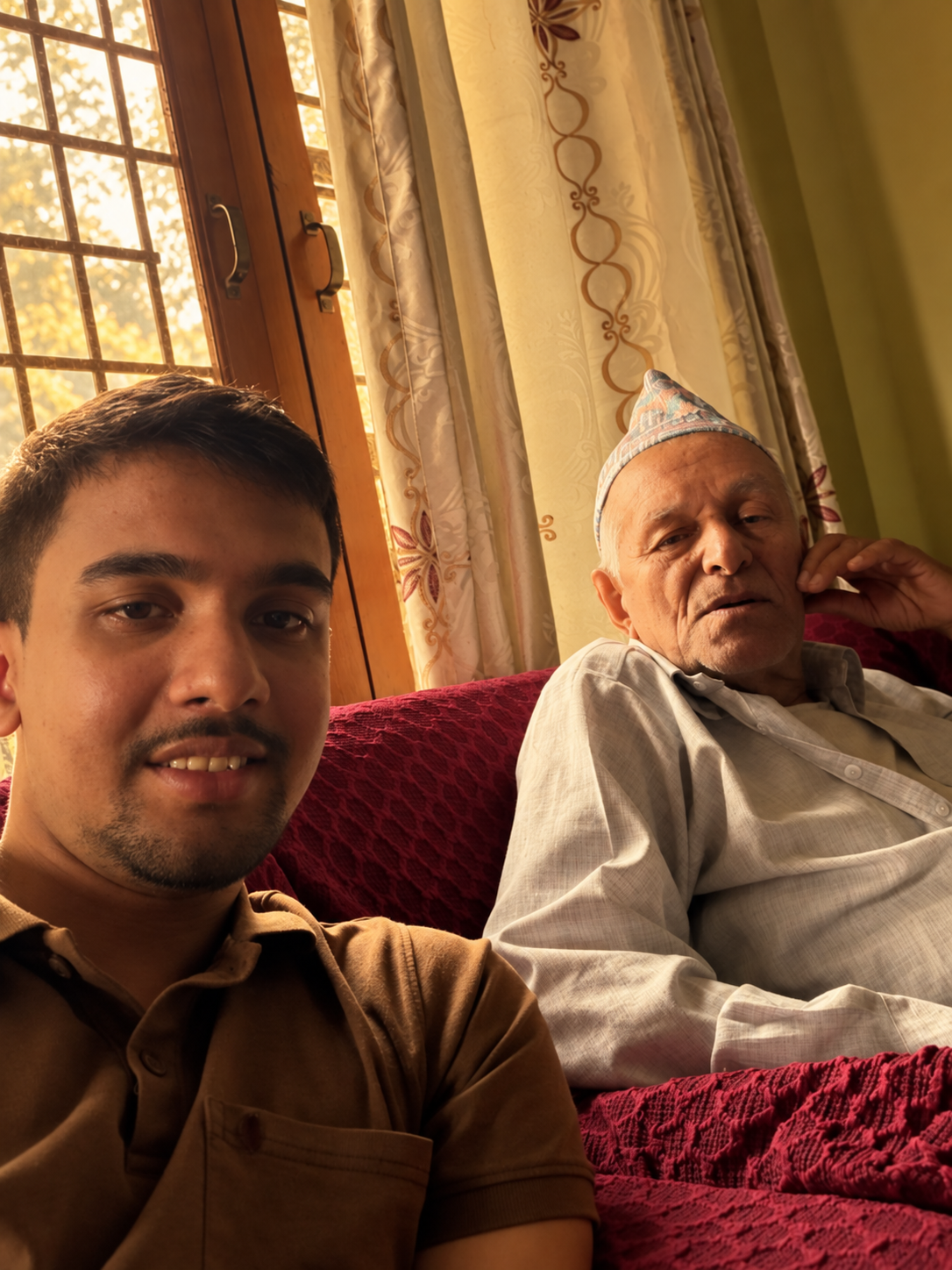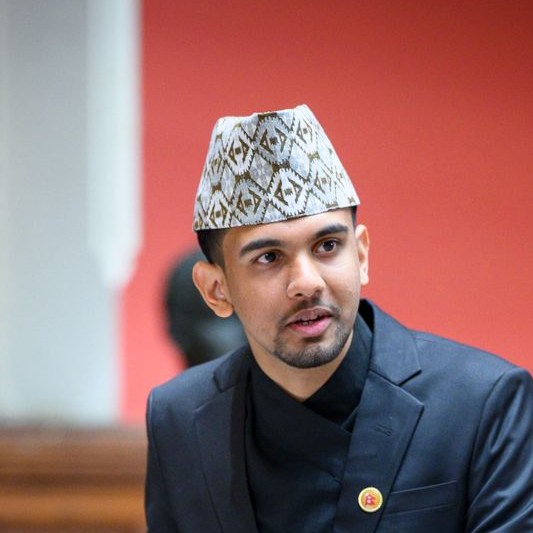
Shaswot Lamichhane

Kathmandu, Nepal

Shaswot
Lamichhane

Between chapters. Still learning.

Stop 01 · Where this starts

Kathmandu, and a habit
of asking why.

Shaswot Lamichhane — better known online as Shalmalo — is an analyst of crowds based in Kathmandu, Nepal, who's stayed curious about how things work since long before it was useful. He's Special Project Lead at Tools for Humanity, building World, a proof-of-human network for an internet increasingly full of AI. In September 2025 he ended up moderating the 145,000-member Discord that helped steer Nepal's Gen Z movement toward an interim government, and later spoke about the experience at the Oxford Union. Beyond any one chapter, he's someone who takes on what's next and tries to actually live it, rather than just get through it.

I grew up here taking things apart in my head. Science was never a school subject to me, it was a toolbox. Physics explains a kitchen. Network theory explains a group chat. The same handful of ideas keep turning up in different clothes.

That habit is the whole story. Everything below is one curiosity wearing different hats: essays, talks, a company building trust systems, and one week in September that turned a private interest into something very public.

  • Kathmanduborn, based, still here
  • 18age during September 2025
  • Shalmalothe handle, most places
  • Tools for HumanitySpecial Project Lead

Stop 02 · How I think

The answer usually exists.
It is filed in the wrong department.

Breakthroughs happen at the edges, where fields overlap. Darwin needed geology. Watson and Crick needed crystallography in the same room as biology. The questions worth asking rarely belong to one discipline, which is why somebody has to carry them across.

Tap a field. See what it lends the others.

Fields: physics, philosophy, leadership, communicating, networks, crowds, biology, systems.

Thermodynamics and a kitchen are the same subject wearing different aprons.

Stop 03 · The question that found me

Why do people behave one way alone,
and another way in a crowd?

I watched Hong Kong. I watched the candlelight marches in Seoul. Not for the slogans, for the patterns. Alone, people are hesitant and inconsistent. Together, the same tendencies replay in different countries like a script.

Coordination without a coordinator.
Momentum without a plan.
A quiet street. Brush your cursor past a few people.
marching
0%

Stop 04 · September 2025

The theory left
the notebook.

Years earlier I had written down a thought. States rarely solve dissatisfaction, they drown it in distraction, and social media is the deepest distraction ever built. Then Nepal banned the platforms overnight.

You are not taking a drug away from one person. You are putting a whole population into withdrawal at once.
  1. Sept 4The ban. Every blank feed becomes a protest poster.
  2. Sept 5 to 7"Do I agree?" quietly turns into "will I show up?"
  3. Sept 8Around 12,000 at Maitighar, many in school uniform. Within hours the state's authority dissolves.
  4. The cost76 people never went home.
  5. Sept 9The prime minister resigns. A vacuum opens and pulls in whatever stands closest.
  6. Sept 9 to 12145,000 people build a process overnight: polls, fact-checking, candidate vetting. I was one of the moderators.
  7. Sept 12Sushila Karki becomes interim prime minister. One job: real elections.
Not a revolution. A stress test. A hollow state met an aligned citizenry, and the state broke first.

Stop 05 · Now

Proving crowds
are made of humans.

I am Special Project Lead at Tools for Humanity, working on World, a proof-of-human network for an internet where AI can imitate anyone. The question moved from "is this crowd coordinated?" to "is this crowd human?", which turns out to be the same problem from the other side.

Alongside that I write, I speak, and I keep an unreasonable number of tabs open.

Building

Proof-of-human systems at Tools for Humanity, and how verification earns trust across very different societies.

Speaking

The Oxford Union, and rooms where the question is what a country owes the people in it.

Reading

Archival protest footage, Twitter and Tear Gas, and whatever philosophy argues with me hardest that week.

The Oxford Union · full address

End of the road, for now

Crowds are unpredictable.
My inbox isn't.

Email me

How Cross-Pollinating Science Leads to Breakthrough Innovation

The answer exists. Wrong department.

The silo problem

Picture two buildings on the same campus. In one, a materials scientist has just found a cheaper way to make silicon wafers. In the other, a professor is telling students that solar technology isn't economically viable. They are a two-minute walk apart, and their knowledge never meets. We treat knowledge like a collection of locked boxes, each with its own key: physics here, psychology there, chemistry sealed away from the art studio. But that isn't how brains work. Understanding is built through many channels firing at once, weaving ideas together.

Where the magic happens

The breakthroughs we celebrate almost never come from the middle of a discipline. They come from the edges, where fields overlap. Darwin's voyage mixed biology with geology, geography, and philosophy. Watson and Crick needed chemistry, biology, physics, and crystallography in the same room to see the double helix. Steve Jobs kept insisting that technology alone wasn't enough. It was technology married to the liberal arts, to typography, to how people actually feel, that made the difference.

The art of teaching physics

Thermodynamics makes sense in a kitchen. Watch a piece of meat reach perfect doneness and you're watching collagen break down, proteins denature, energy move between molecules, the same principles that run stars and engines. Teach quantum physics through poetry and you find that Heisenberg's uncertainty principle says something artists have always known intuitively: the act of looking changes the thing you look at.

The neuroscience of understanding

When you deeply understand something, your brain doesn't light up in one tidy region. Visual processing, emotional memory, language, and abstract reasoning fire together, building a rich, interconnected representation. Teaching subjects in isolation asks students to think with a fraction of their capacity, like painting with one color, or composing with one instrument.

The Renaissance mindset

Renaissance thinkers never agreed to the locked boxes in the first place. Leonardo's anatomical drawings are scientifically precise and artistically beautiful, and his machines balance function with elegance, because to him these were never separate pursuits.

Breaking down the walls

Our institutions still reward specialization over integration; the incentives all point inward. Yet the most innovative companies and the most interesting researchers are the ones asking sideways questions. What does biology know that could help this piece of software? What does a chef understand that a chemist has forgotten?

The path forward

None of this means abandoning depth. It means recognizing that real expertise includes knowing how your field connects to the ones next door. Education should look more like actual learning: messy, creative, driven by stories rather than syllabi.

The spark

The most profound discoveries are waiting at the intersections, where different ways of knowing meet and make something entirely new. The most important questions don't belong to any single field, which is exactly why someone has to carry them across the walls.

More essays are on the way. If this one sparked something, or you disagree in an interesting way: saswot.dev@gmail.com.